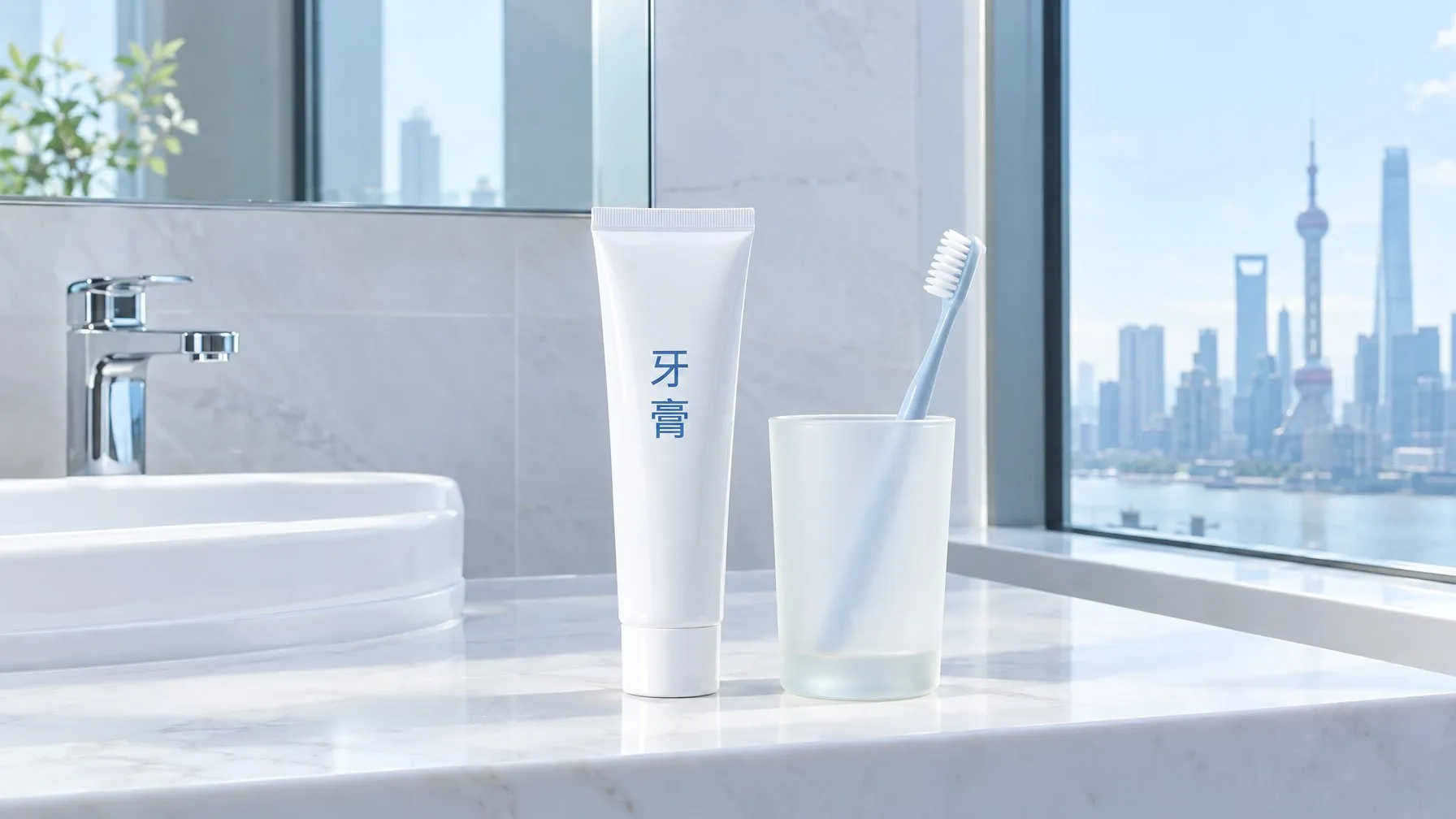
Toothpaste in Chinese is 牙膏 (yá gāo), literally “tooth paste.” To buy it, say 我想买牙膏 (wǒ xiǎng mǎi yá gāo), “I want to buy toothpaste,” or simply ask 牙膏在哪儿? (yá gāo zài nǎr?), “Where is the toothpaste?” This guide gives you the word, the phrases for the toiletries aisle, and the label terms that keep you from guessing at the shelf.
You will find toothpaste in every supermarket, convenience store, and pharmacy in China, usually in the same aisle as shampoo and soap, so this is vocabulary you will use in your very first week. Knowing the characters also helps you spot the right tube in seconds instead of scanning for English logos.
Table of Contents
Key Takeaways
- Toothpaste in Chinese is 牙膏 (yá gāo): 牙 (tooth) plus 膏 (paste).
- Toothbrush is 牙刷 (yá shuā) and brushing your teeth is 刷牙 (shuā yá).
- Buy it with 我想买牙膏 (I want to buy toothpaste) or locate it with 牙膏在哪儿? (Where is the toothpaste?).
- Label words worth knowing: 美白 (whitening), 含氟 (with fluoride), 抗敏感 (for sensitive teeth).
- Toothpaste is everywhere in China: supermarkets, convenience stores, pharmacies, and Watsons (屈臣氏).
The core word: 牙膏
牙膏 is the everyday word for toothpaste: on the tube, on the receipt, and in every store. It is a friendly first word for learners, and ChineseClass101’s core words lesson on toothbrush and toothpaste covers the pair with native audio if you want to hear both spoken slowly.
Character breakdown: 牙 and 膏
牙 (yá) means tooth, and it is the same character you will meet in 牙刷 (toothbrush) and 牙医 (dentist). 膏 (gāo) means paste or ointment, the same 膏 as in 药膏 (yào gāo), medicinal ointment. Tooth plus paste: toothpaste. Once you know 牙, a whole family of dental words opens up, and our guide to how to say dentist in Chinese is the natural next step.
Related words: toothbrush, mouthwash, dental floss
The closest neighbor is 牙刷 (yá shuā), toothbrush, where 刷 means to brush. 刷牙 (shuā yá) is the act of brushing your teeth, as in 我每天早上刷牙 (wǒ měi tiān zǎo shang shuā yá), I brush my teeth every morning. Two more shelf neighbors: 漱口水 (shù kǒu shuǐ), mouthwash, literally “rinse mouth water,” and 牙线 (yá xiàn), dental floss, literally “tooth thread.” And when someone drags information out of you bit by bit, Chinese has an idiom for that too: 挤牙膏 (jǐ yá gāo), “squeezing the toothpaste tube,” which is exactly what the GoEast Mandarin video above plays with.
Key phrases for buying toothpaste in Chinese
Two sentences cover almost every shopping trip, and a handful of label words handle the rest, because toothpaste in Chinese is one of those words you say more often than you expect.
At the store: 我想买牙膏 and 牙膏在哪儿?
Start with 我想买牙膏 (wǒ xiǎng mǎi yá gāo), “I want to buy toothpaste,” when a staff member offers help. If you are hunting on your own, ask 牙膏在哪儿? (yá gāo zài nǎr?), “Where is the toothpaste?” For a specific type, the pattern is 有…吗?: 有抗敏感牙膏吗? (yǒu kàng mǐn gǎn yá gāo ma?), “Do you have toothpaste for sensitive teeth?” If you blank on a word at the shelf, the Pleco dictionary app can scan the characters on the tube with your camera and translate them on the spot.
Reading the label: 美白, 含氟, 抗敏感
Chinese toothpaste tubes are dense with useful vocabulary. 美白 (měi bái) means whitening, 含氟 (hán fú) means contains fluoride, 抗敏感 (kàng mǐn gǎn) means anti-sensitivity, 防蛀 (fáng zhù) means anti-cavity, and 牙龈 (yá yín) means gums, as in 牙龈出血 (bleeding gums). Flavor words are easy wins too: 薄荷 (bò he) is mint, and 清新口气 (qīng xīn kǒu qì) promises fresh breath. Learn these six and every tube in the aisle becomes readable.
Where to buy toothpaste in China
Saying toothpaste in Chinese is easy; finding it is even easier, since it is one of the most widely stocked items in the country. Every supermarket (超市, see our guide to how to say supermarket in Chinese) stocks a full wall of it, convenience stores carry the big brands, and any pharmacy (药店, covered in how to say pharmacy in Chinese) sells the herbal and medicated varieties. It usually sits in the 日用品 (daily necessities) aisle together with shampoo, soap, and bath towels, so one aisle restocks your whole bathroom. TravelChinaGuide’s overview of where to shop in China maps out the store types, from roadside shops to supermarkets, so you know which door to walk through.
Brands you will see on the shelf
The tube you will see everywhere is 云南白药 (Yún nán bái yào), the herbal giant whose formula is a state-protected secret and whose white and blue box dominates the aisle. The international brands wear Chinese names: 佳洁士 (jiā jié shì) is Crest, 高露洁 (gāo lù jié) is Colgate, and 好来 (hǎo lái), the former 黑人牙膏, is the brand many locals grew up with. Prices are gentle: a standard tube runs about 10 to 30 kuai, so experimenting is cheap.

When toothpaste turns into a dentist visit
Sometimes the toothpaste question is really a dentist question. If your gums keep bleeding or a tooth aches, 牙医 (yá yī) is the word you need, and our guide to how to say dentist in Chinese walks through booking a visit. If the concern is more social than medical, how to say bad breath in Chinese covers 口臭 and the polite ways around it. Expat-oriented dental care has grown quickly in the big cities: The Beijinger’s look at Beijing’s international dental clinics explains what changed and what expats can expect.
Practice your toothpaste script
Run a one-minute drill before your next shopping trip: say 牙膏 three times, then 我想买牙膏, then the full question 有美白牙膏吗? (Do you have a whitening one?). Saying the words out loud is what makes them come out naturally at the shelf. Want a head start on real conversations? Join italki through our link and $10 in credits lands in your account after your first purchase, plenty for a discounted trial lesson where a teacher can drill this exact shopping scenario with you.
Picture your next restock: you walk into Watsons, ask 牙膏在哪儿?, and add 有薄荷味的吗? (Do you have a mint one?) at the shelf. Thirty seconds of Mandarin, and the tube in your basket is the one you actually wanted. Skip the phrase, and you are back to pointing at shelves and hoping for the best.
Frequently Asked Questions
How do you say toothpaste in Chinese?
Toothpaste in Chinese is 牙膏 (yá gāo), literally “tooth paste”: 牙 means tooth and 膏 means paste or ointment, which makes toothpaste in Chinese one of the most transparent words you will learn. It is the standard word used across mainland China, on packaging, in stores, and in conversation.
How do you say toothbrush in Chinese?
Toothbrush in Chinese is 牙刷 (yá shuā): 牙 (tooth) plus 刷 (brush). An electric toothbrush is 电动牙刷 (diàn dòng yá shuā). The pair 牙膏 and 牙刷 are usually sold side by side, so learning them together pays off immediately.
How do you say brush your teeth in Chinese?
Brush your teeth in Chinese is 刷牙 (shuā yá), literally “brush teeth.” A full sentence: 我每天早上刷牙 (wǒ měi tiān zǎo shang shuā yá), I brush my teeth every morning. To say you brush with toothpaste, add 用牙膏: 我用牙膏刷牙, I brush my teeth with toothpaste.
Where can you buy toothpaste in China?
Everywhere: supermarkets, convenience stores, pharmacies, and personal-care chains like Watsons (屈臣氏). Look for the 日用品 (daily necessities) aisle, where toothpaste sits next to shampoo, soap, and towels. Prices for a standard tube run roughly 10 to 30 kuai depending on the brand.
What do the words on Chinese toothpaste tubes mean?
The six most useful label words: 美白 (měi bái, whitening), 含氟 (hán fú, contains fluoride), 抗敏感 (kàng mǐn gǎn, for sensitive teeth), 防蛀 (fáng zhù, anti-cavity), 牙龈 (yá yín, gums), and 薄荷 (bò he, mint). If a word stumps you, a camera dictionary app like Pleco reads the tube instantly.
What is the most popular toothpaste brand in China?
云南白药 (Yunnan Baiyao), the herbal toothpaste built on a state-protected traditional medicine formula, is the dominant domestic brand and a common default in Chinese homes. The familiar international names are there too: Crest is 佳洁士 (jiā jié shì) and Colgate is 高露洁 (gāo lù jié).